Music offers a uniquely structured and expressive world where patterns, sounds, and movement converge. For many autistic children and teens, the piano becomes a safe, clear map of pitch and rhythm that can reduce anxiety while building communication, focus, and confidence. When instruction is adapted to individual strengths and sensory profiles, piano lessons for autism can unlock genuine joy and measurable growth—not only in music, but across daily life skills.
Why the Piano Is a Powerful Learning Pathway for Autistic Students
The piano’s design naturally supports learning. Keys are laid out in a predictable visual and tactile sequence, making it easier to grasp pitch relationships and intervals. Each key produces immediate, reliable feedback, so students can associate specific movements with specific sounds without guesswork. This clear cause-and-effect loop is especially helpful when attention, auditory processing, or sequencing are challenging. It also supports errorless learning, where successes are scaffolded and reinforced before complexity increases.
For many autistic learners, sensory regulation is a priority. The piano enables precise control over volume and touch, allowing students to explore dynamics without overwhelming sensory input. Teachers can guide learners to notice how softer playing can soothe or how structured rhythms can help organize thoughts and movement. Over time, students discover self-regulation strategies embedded in music—counting silently to reset, breathing in tempo, or using steady left-hand patterns as a grounding technique. These are transferable tools for school, home, and community settings.
Motor development also benefits. Coordinating two hands, crossing the midline, and controlling finger isolation build fine motor skills that can complement occupational therapy goals. Repetitive, patterned practice strengthens working memory, timing, and executive functions like planning and task initiation. Importantly, the piano supports interest-based learning. When lessons are anchored in a student’s favorite melodies, game themes, or movie scores, motivation skyrockets. A learner who struggles with transitions may move smoothly from warm-ups to repertoire when a preferred song awaits at the end.
Social-communication growth can be woven into music-making. Duets cultivate turn-taking; call-and-response improvisations build joint attention; and ensemble experiences foster listening, collaboration, and flexible thinking. With the right teacher, piano lessons for autistic child learners can become a platform for celebrating strengths while gently addressing challenges. The result is not a one-size-fits-all method but a tailored pathway that respects processing speed, sensory needs, and expressive preferences—spoken, sung, played, or typed via AAC.
Adaptive Teaching Strategies: From First Notes to Independent Musicianship
Effective instruction starts with a strengths assessment: what captures attention, which sensory inputs are calming or alerting, and how the learner communicates. A predictable session flow—greeting, sensory check-in, warm-up, main tasks, choice activity, and closing—reduces anxiety and improves engagement. Visual supports such as first/then boards, color-coded landmarks on keys, or simplified notation help demystify abstract concepts. As mastery grows, supports are faded to promote independence, honoring autonomy and avoiding prompt dependence.
Chunking is essential. Complex pieces are broken into micro-skills: rhythmic claps, single-hand patterns, then coordinated hands with a slow metronome. Motor learning is reinforced through short, frequent repetitions with generous success. Teachers can use differential reinforcement—praising accuracy, effort, and self-advocacy—and offer flexible response modes. A student might point to a key, name a note, or play it; all three can demonstrate understanding. For some, ear-first approaches work best; for others, a visual pathway or a hybrid of lead sheets and chord symbols opens the door.
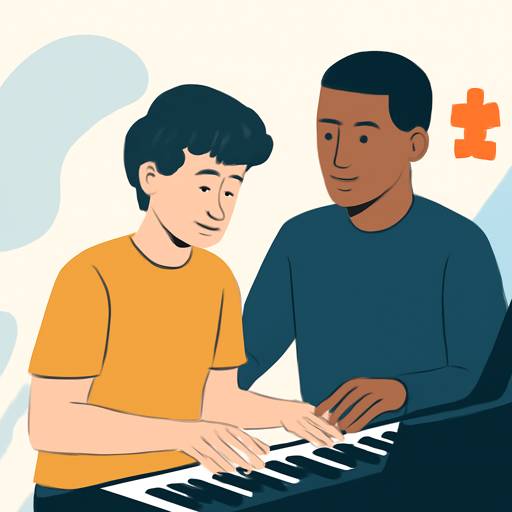
Embracing stimming and movement enhances focus. Squeezable objects, a brief wall push, or a rocking stool break can reset arousal levels. Many students regulate better when they begin with an “anchor” routine, such as a favorite scale in a calming tempo. Improvisation is a powerful tool: left-hand ostinatos with free right-hand exploration invite self-expression without a fear of wrong notes. Composition—building short motifs from a student’s name or a favorite color pattern—encourages agency and narrative play.
Home practice succeeds when it’s simple, visual, and connected to intrinsic interests. A five-minute “power practice” plan with one clear target is more effective than a vague 30-minute assignment. Timers, sticker charts chosen by the learner, and audio/video check-ins can sustain momentum. Technology supports accessibility: MIDI keyboards for soft-touch response, notation apps that enlarge staves, or loopers for repetitive motor learning without fatigue. Through these adjustments, piano lessons for autism become a personalized curriculum that nurtures musicality while strengthening executive skills, self-regulation, and communication.
Choosing a Specialist and Building a Supportive Team: Case Studies and Practical Steps
The right fit matters as much as the curriculum. Look for educators who can describe their adaptive process, not just their credentials. A specialist should ask about sensory preferences, communication modes (speech, AAC, gestures), motor profile, and co-occurring conditions like ADHD, dyspraxia, or anxiety. Observe how a teacher structures a trial lesson: Is there a clear routine? Are choices offered? Does the teacher adapt in real time and honor breaks? Progress should be documented with specific goals—such as increasing left-hand independence or sustaining attention through a three-step task—rather than generic milestones.
Collaboration ensures continuity. Coordinating with caregivers, therapists, and educators aligns supports across environments. If a student uses visual schedules or a token economy at school, similar tools can appear in the studio. For learners with IEPs, the music teacher can mirror accommodations like extra processing time, reduced visual clutter, or alternate assessments. Communication should be consistent and concise: short session summaries, an adjusted practice plan, and a preview of the next step help everyone prepare for success. In many cases, partnering with a dedicated piano teacher for autism streamlines this teamwork from day one.
Case Study 1: An eight-year-old, non-speaking student using a speech-generating device began with five-minute sessions focused on cause-and-effect sounds and steady-beat games. Visual schedules and key markers supported early accuracy. After eight weeks, the student could play a two-note ostinato while choosing right-hand pitches for a call-and-response improvisation. Over six months, the child learned a short melody by color-coded notation, gradually transitioning to letter names. Gains extended beyond music: improved turn-taking with siblings and longer on-task duration during homework.
Case Study 2: A twelve-year-old who loved film scores but struggled with task initiation thrived on a “menu” lesson format—warm-up choices, repertoire choices, and a creative choice. The teacher integrated chord-based lead sheets, allowing early wins with recognizable themes. A metronome app with visual pulsing reduced auditory overstimulation. Within three months, the student performed a simplified arrangement at a studio sharing session, reporting lower pre-performance anxiety after practicing square breathing in tempo. Executive function improved at home, with the learner initiating two independent five-minute practice blocks most days.
When evaluating a piano teacher for autistic child needs, prioritize patience, curiosity, and a strengths-first lens. Ask how the teacher adapts for sensory differences, what success markers are used, and how they balance routine with novelty. Request a trial period to ensure rapport, and ensure policies allow flexibility for health or sensory days. Whether lessons occur in person or online, the environment should be predictable, visually calm, and set up for communication—sheet music large enough to read comfortably, camera angles that clearly show hands for virtual lessons, and easy access to fidgets or movement breaks.
Above all, choose a teacher who treats the learner as a collaborator. With respectful accommodations, evidence-informed strategies, and consistent communication, piano lessons for autistic child musicians become more than a weekly activity—they become a meaningful avenue for expression, mastery, and self-advocacy that can resonate for a lifetime.

Kathmandu mountaineer turned Sydney UX researcher. Sahana pens pieces on Himalayan biodiversity, zero-code app builders, and mindful breathing for desk jockeys. She bakes momos for every new neighbor and collects vintage postage stamps from expedition routes.